SET SAIL IN THE WAKE OF TRADITION!
Sail trainees setting sail on Tall Ship Blue Clipper!
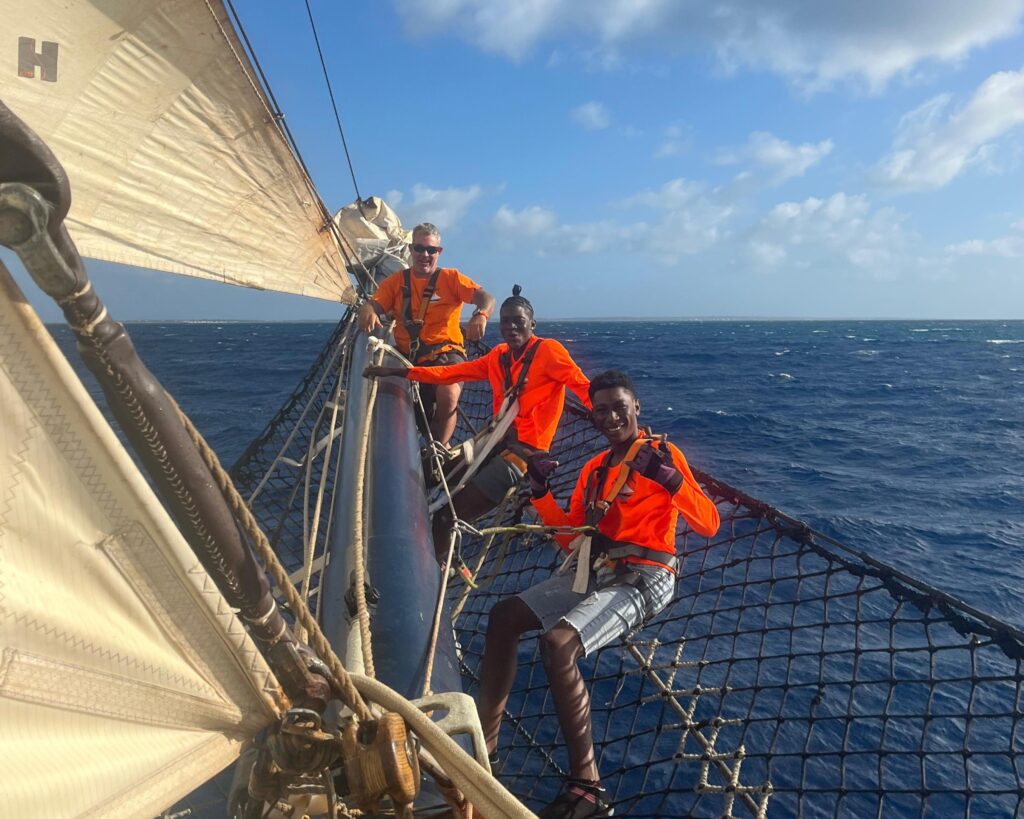
Full of excitement and ready for adventure, sail trainees Kaemoy and Preston, accompanied by Billy, the Founder of the West Indies Sail Heritage Foundation, began their incredible journey aboard the majestic Tall Ship Blue Clipper, sailing from Antigua to St Maarten. A voyage that would test their endurance and expand their horizons in ways they had never imagined.
The West Indies Sail Heritage Foundation collaborates with Caribbean Sail Training https://www.caribbeansailtraining.com/ and Sail Training International https://sailtraininginternational.org/sailtraining/ to offer sail training opportunities to Antiguan Youngsters. Although Antigua is known as a sailing paradise, sailing opportunities for local youth are limited, especially the chance to sail the majestic traditional Tall Ships.

What is Sail Training?
Sail training is a form of experiential learning in which young people go to sea on traditional sailing vessels and take part as active crew members rather than as passengers. Trainees work alongside professional sailors to actually run the ship: hoisting sails, steering, standing night watch, climbing rigging, and taking responsibility for daily shipboard life.
Sail training instils confidence and fosters teamwork, cultivating strong communication skills, trust, and respect for others. It serves as a bridge to our maritime heritage. Traditional ships are living museums and sailing them offers trainees a profound connection to centuries of seafaring history long before the advent of modern engines.

About the Blue Clipper
Built in 1991 at the Feab Marstrandsverken shipyard in Sweden, the Blue Clipper carried decades of stories within her steel hull and across her teak deck. Her design as a three-masted gaff rig schooner gave her a distinctive elegance, with sails rigged fore to aft along the length of the ship. Ten sails, stretching across an impressive 675 square meters, worked together to harness the wind, while her steel masts and wooden booms stood as a testament to both strength and craftsmanship.

Getting Ready
Safety First at Sea. The First Lesson on Tall Ship Blue Clipper!
Before a single sail is hoisted and the ship catches the wind, there’s one tradition that always comes first on board a Tall Ship: safety.
When sail trainees Kaemoy and Preston stepped aboard the Tall Ship Blue Clipper , their journey into traditional sailing began not with ropes and sails, but with a full safety briefing, an essential part of life at sea.
On traditional sailing vessels, every crew member has a role and every piece of equipment has a purpose. They were introduced to key gear used by Tall Ship sailors, including inflatable PFDs worn at night or in heavy weather, safety harnesses used when climbing aloft or working near the bowsprit, and immersion suits designed to protect against cold water.
And of course, no safety training is complete without a little challenge! Preston had everyone smiling as he raced to put on his immersion suit in under two minutes!
Then came the drills. The “man overboard” and the fire drill were taken seriously. They practiced gathering at designated muster stations, understanding that in an emergency, confusion could be dangerous.
At first, it all felt overwhelming. There was so much to remember, so many details to take in. But as the crew patiently guided them through each step, confidence began to replace uncertainty. By the end of the drills, Kaemoy and Preston no longer felt like outsiders; they felt prepared.
Check the video clip of the safety drills on YouTube https://youtube.com/shorts/UCdifMkaZjM?feature=share

Setting Sail
Looking at the bowsprit from the deck was intimidating enough. Climbing outside at the end of the bowsprit to untie the sails was something else entirely. Harnessed and guided, Kaemoy and Preston experienced their first climb out.
“Haul together!” came the call as the ship prepared to leave port. Hoisting sails was their first real test. The ropes were thick and heavy, their movements requiring coordination and timing. At first, it felt chaotic, but slowly, they began to understand. With the crew’s guidance, they found their footing. Pull by pull, they worked in unison until the sails finally rose and filled with wind.
Life on board quickly settled into a steady rhythm. There was always something to be done. Sailing a traditional ship like Blue Clipper required constant attention, and Preston and Kaemoy were expected to fully participate.
Night watch became one of the most memorable parts of their journey. Standing on deck in the quiet darkness, with only the stars and the sound of the ocean surrounding them, they experienced a different side of sailing. The ship moved steadily, guided by wind and careful hands. Being on watch wasn’t just about observing; it was about awareness. They learned to read the wind, to notice subtle changes, and to stay alert even when the world seemed still. Navigation sessions introduced them to chart work and course plotting. They learned how sailors long before them had relied on similar skills to cross oceans. It was a reminder that while technology has advanced, the fundamentals of sailing remain deeply rooted in tradition.
One of the most powerful lessons came through teamwork. On a ship like Blue Clipper, nothing happens alone. Every sail raised, every course adjusted, every watch completed depends on collective effort. Kaemoy and Preston learned to trust not only the crew but also each other.

Life aboard Blue Clipper was demanding. Kaemoy and Preston quickly learned that being part of a tall ship crew meant long hours and constant effort. They hoisted and trimmed sails under the hot Caribbean sun, stood watch through the quiet stillness of the night, and took turns at the helm, feeling the immense responsibility of steering such a powerful vessel.
By the time they approached St. Maarten, they stepped ashore not just as participants, but as sailors. They carried with them more than memories; they carried resilience, skills, and a deep appreciation for the sailing tradition they had become part of.
The West Indies Sail Heritage Foundation aims to inspire young people to embrace sailing, discover the ocean and connect with international youngsters. This program fosters appreciation for traditional sailing and maritime heritage, creating lasting memories and connections that celebrate our shared love for the sea.

We are grateful to our sponsors for making this happen
We extend our sincere thanks to the Captain and Crew of the Blue Clipper and for opening their decks and sharing their knowledge with the next generation of mariners.
This opportunity is made possible through collaboration with Caribbean Sail Training and sponsorship from Sail Training International, whose continued support helps young Caribbean sailors experience life aboard traditional ships.
We’re excited to continue this journey together, and we can’t wait to welcome the Blue Clipper back to Antigua next year!
-
- Tall Ship Blue Clipper: www.maybe-sailing.com/ship/blue-clipper
- Caribbean Sail Training: www.caribbeansailtraining.com
- Sail Training International: https://sailtraininginternational.org/sailtraining/


